Let be the dimensionality of the data:
- : signals (e.g., audio, text)
- : images
- : videos or volumetric data (e.g., CT, MRI)
- : multi-dimensional tensors (e.g., scientific or structured data)
Definition
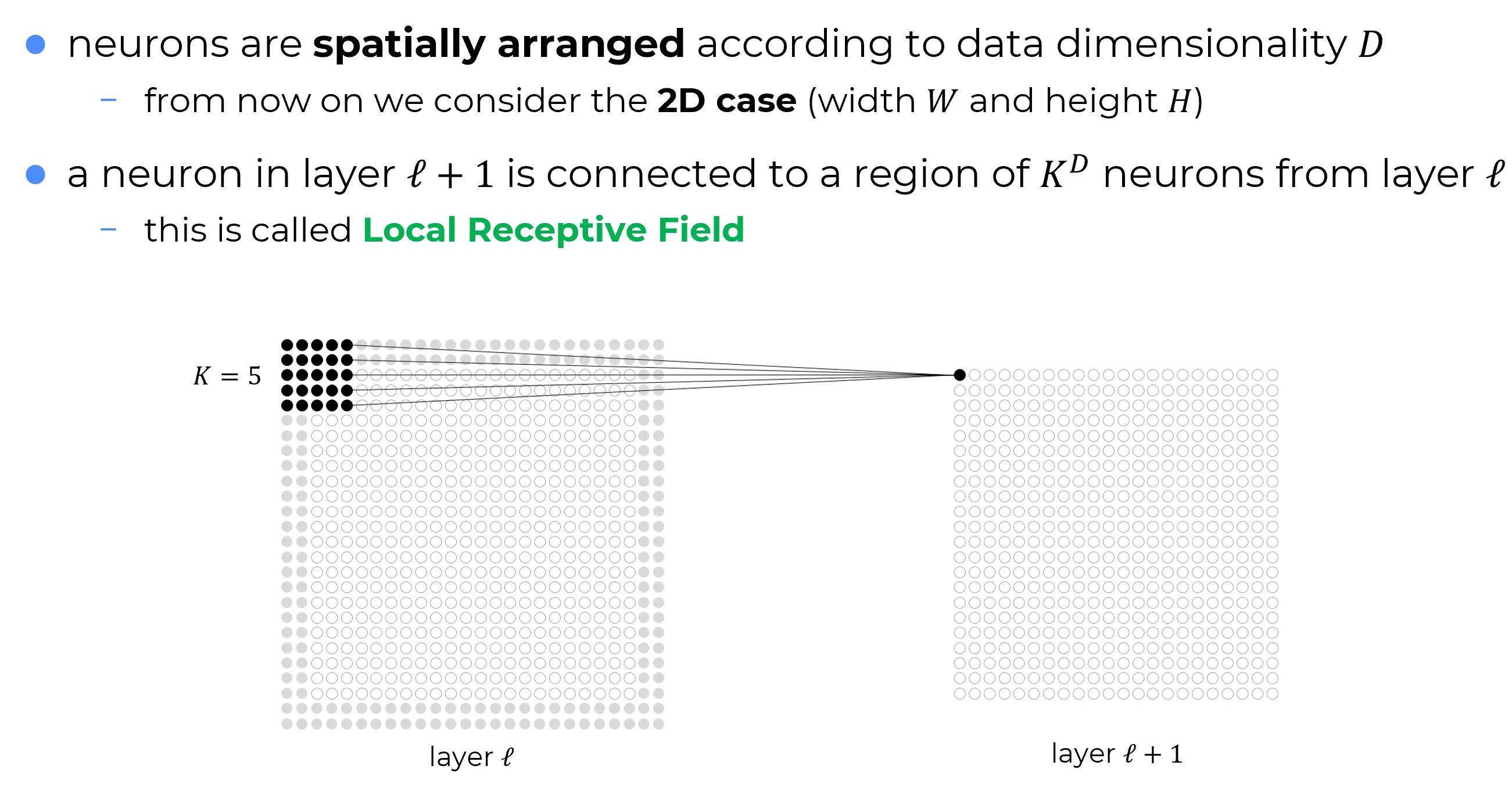
A Local Receptive Field is a multidimensional window of shape , consisting of neurons (activations) from the previous layer , to which a single neuron in the next layer is sensitive to.
Note
If all dimensions are equal (), the LRF is an isotropic hypercube of size (e.g. in 2D, in 3D).
Why it is called LRF?
- Receptive field is a term borrowed from neurophysiology: cells in the visual cortex activate when a stimulus appears in a specific region of the retina.
- Local because, unlike in an MLP where each neuron of a layer is connected to all the neurons of the previous layer (i.e. fully connected), here the neuron of a layer is connected only to a small, localized region of the previous layer.
2D isotropic case
If then the LRF is a window of shape . This means that each neuron in the next layer observes only a window of 25 activations from the previous layer. Therefore:
- in the input layer, these activations correspond to raw pixels (images) or samples (1D signals).
- in deeper layers, they correspond to more abstract features computed by the network.
The Local Receptive Field (LRF) concept remains the same — only the nature of the observed units changes.
Examples of anisotropic LRFs
While isotropic kernels (e.g. in 2D) are the most common in CNNs, some domains benefit from anisotropic (non-square / non-cubic) LRFs:
- Text / OCR → tall and narrow windows () capture vertical strokes.
- Audio / Spectrograms → wider windows () capture frequency bands.
- Medical imaging → anisotropic kernels match slice spacing in CT/MRI volumes.
In short, the shape of the LRF can be adapted to the structure of the data and the orientation of patterns of interest.
Problems solved by LRF
| 🔴 MLP Problem | ✅ How LRF solves it |
|---|---|
| Loss of geometry → flattening the image into a vector destroys the potential correlation among neighboring pixels. | The local window preserves the spatial arrangement: edges, textures, and patterns remain interpretable. |
LRF: CNN vs MLP ()
| CNN Neuron (Activation of a Feature Map) | MLP Neuron | |
|---|---|---|
| 🔗 Connections | Local () | Fully connected |
| 👁️ Receptive field | Limited ( activations) | Global over the entire input |
Final Remark
A neuron does not “see” the entire input, but only the local portion defined by the LRF.
Il Campo Recettivo Locale (LRF) di un neurone in una feature map definisce la regione nell’input (i.e. la feature map di input) i cui valori influenzano l’attivazione del neurone stesso (i.e. la regione nell’input a cui il neurone è sensibile). Esso quantifica il “contesto” spaziale che un neurone è in grado di “vedere”.