Abstract
Artificial intelligence has never been a single method. Its history is the interaction of several paradigms, each built on a different answer to how knowledge should be represented, how learning should occur, and how solutions should be found. This note is a map of those paradigms: their core commitments, their periods of greatest influence, and their present standing. The recurring lesson is that they did not so much replace one another as accumulate, and that the strongest modern systems combine them.
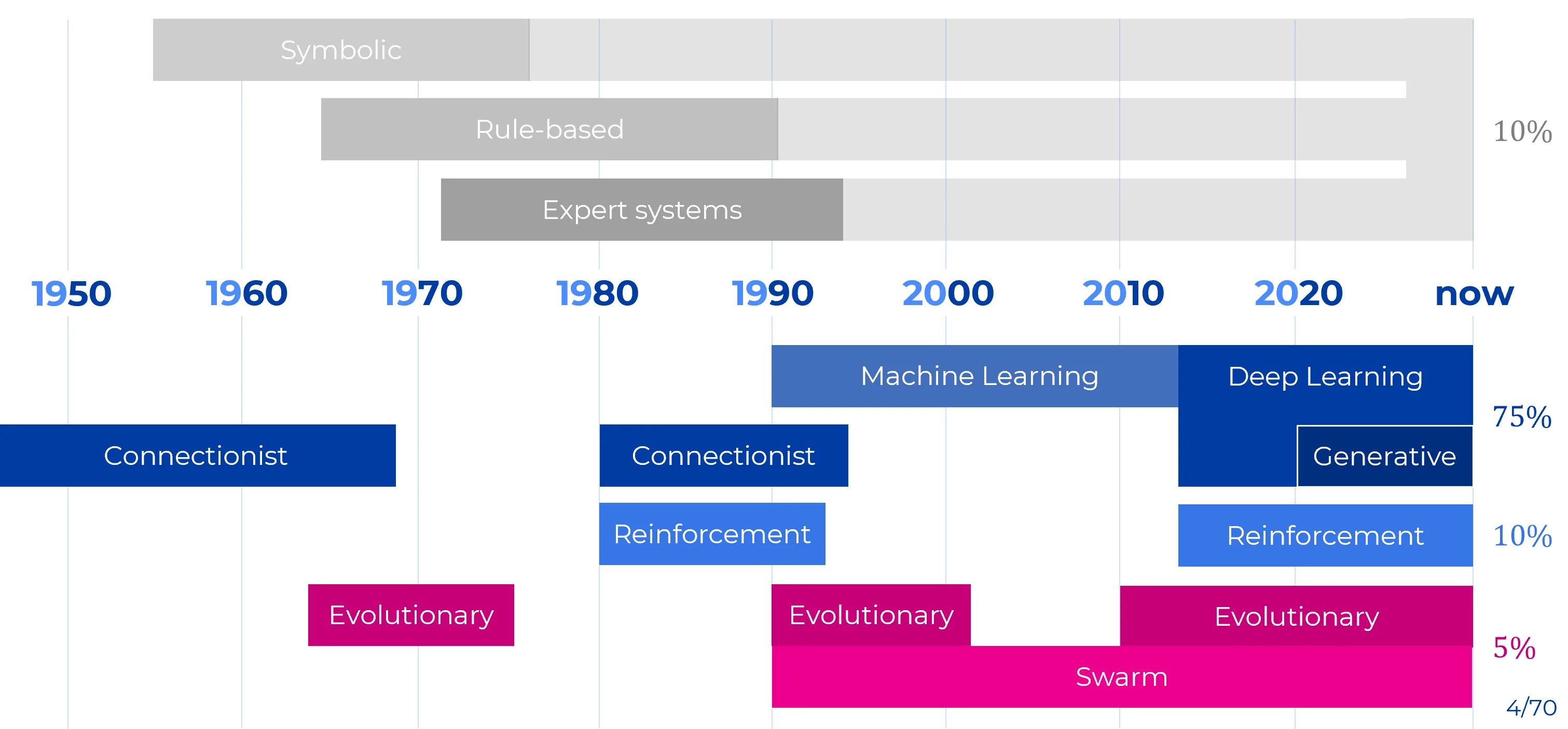
The paradigms below are not all the same kind of thing, and ranking them on a single axis obscures more than it reveals:
- Symbolic AI, statistical learning, and connectionism are broad traditions of representation and learning.
- Reinforcement learning is a framework for learning through interaction and reward.
- Evolutionary and swarm methods are families of gradient-free search.
Because they answer different questions, they routinely appear together inside the same system, and the useful question is rarely which paradigm wins but which combination fits the problem.
A map of the field
| Paradigm | Foundational question | Core commitment | Historical peak | Contemporary status |
|---|---|---|---|---|
| Symbolic AI | How can intelligence be expressed through explicit knowledge and formal reasoning? | Symbols, logic, rules, structured inference | 1950s-1980s | Specialised but indispensable |
| Statistical machine learning | How can predictive structure be inferred from data under uncertainty? | Probability, geometry, estimation, regularisation | 1990s-2010s | Foundational and still active |
| Connectionism / deep learning | How can internal representations be learned through adaptive networks? | Distributed representations, end-to-end learning, scalable optimisation | 2012-present | Dominant paradigm |
| Reinforcement learning | How should an agent act to maximise long-term reward? | Interaction, delayed feedback, sequential decision-making | 1990s-present, surging after 2013 | High-value specialised paradigm |
| Evolutionary / swarm intelligence | How can strong solutions emerge without gradients or explicit models? | Population-based search, selection, decentralised optimisation | 1960s-present | Durable niche |
The dates in the last two columns mark shifts of emphasis, not extinctions. A method can lose cultural centrality while remaining the best tool in the domains where its assumptions hold.
Symbolic AI (1950s-1980s)
The symbolic tradition, often called Classical AI or GOFAI (Good Old-Fashioned AI), treated intelligence as the manipulation of explicit symbols according to formal rules. If the right representation and inference procedure are available, the view holds, intelligent behaviour can in principle be derived by reasoning. This produced logic programming, rule-based systems, the expert systems that found commercial success in the 1970s and 1980s, and automated theorem proving.
Its strength is explicit structure: knowledge is interpretable, rules can be audited, and formal guarantees are sometimes possible, which makes symbolic methods valuable wherever correctness and compositional control matter. Its weakness is the mirror image. Symbolic systems are brittle in noisy environments, expensive to author by hand, and poorly suited to perception, where the relevant structure is not given in symbolic form. The lasting contribution is a question rather than a technique: whether intelligence is fundamentally structured reasoning over explicit representations. That question still shapes work on planning, verification, and neuro-symbolic integration.
Statistical machine learning (1990s-2010s)
The statistical paradigm shifted the emphasis from hand-authored rules to inference from data. Rather than encoding intelligence symbolically, it asked how predictive structure could be estimated from examples using probability, geometry, and optimisation. Its methods span probabilistic and graphical models, kernel methods such as support vector machines, the classical supervised toolkit of logistic regression, decision trees, and boosting, and unsupervised techniques such as PCA and clustering.
Its contributions are conceptual as much as practical: an explicit treatment of uncertainty, rigorous thinking about generalisation, principled regularisation, and strong performance on small-data, tabular, and structured problems. Its limits surfaced where hand-engineered features were inadequate and raw, unstructured data such as images, audio, and text demanded that representation itself be learned. Deep learning did not arrive in an empty field; it inherited the statistical paradigm’s central concerns, optimisation, regularisation, generalisation, and latent structure, and kept them.
Connectionism and deep learning (1940s-present)
Connectionism treats intelligence as an emergent property of large networks of simple adaptive units: rich behaviour need not be programmed if the system can learn expressive internal representations from data. Its defining strength is representation learning. A neural network does not merely map inputs to outputs; it learns an internal space in which the problem becomes easier, which is why it succeeded so decisively in perception and generation.
This is the dominant paradigm of the present, and it has its own treatment across this chapter: the connectionist idea in depth, the artificial neuron it is built from, and its milestones in the histories of neural networks, deep learning, and Transformers. The same core specialises into convolutional and recurrent networks, Transformers, graph networks, and generative models without changing its principles.

Its limits are as real as its successes: dependence on large datasets and compute, limited interpretability, vulnerability to distribution shift, and difficulty providing formal guarantees, which surface in generative systems as hallucination and unreliable reasoning.
Reinforcement learning (1980s-present)
Reinforcement learning studies how an agent should choose actions to maximise cumulative reward over time. It differs from supervised learning because the correct action is not given; it must be discovered through interaction, exploration, and delayed feedback. Its arc runs from temporal-difference learning and Q-learning, through the deep-RL breakthroughs of DQN and AlphaGo, to MuZero, robotics, and the preference-based alignment methods (RLHF) that returned RL to prominence in the language-model era.
RL is not a representational rival to symbolic AI or connectionism; it is a framework for agency, and it composes with neural policies, symbolic world models, search, or learned reward signals. Its enduring importance lies in formalising one of the hardest problems in AI: how to act under uncertainty when feedback is delayed and consequences unfold over time, which demands policy formation and credit assignment across time.
Evolutionary computation and swarm intelligence (1960s-present)
Evolutionary and swarm methods solve problems through population-level search rather than gradient descent or symbolic derivation, on the premise that useful structure can emerge through variation, selection, recombination, or decentralised collective behaviour. Genetic algorithms target combinatorial optimisation; evolution strategies such as CMA-ES provide gradient-free policy search; swarm methods such as particle swarm and ant colony optimisation coordinate decentralised search.
These approaches earn their place when the objective is discontinuous or poorly behaved, when gradients are unavailable or misleading, or when many candidate solutions must be explored in parallel. They remain strategically important in neural architecture search, hyperparameter optimisation, engineering and morphology design, and robust search in non-differentiable spaces.
The present: hybrid systems
The most capable contemporary systems no longer fit neatly inside a single paradigm.
| Hybrid configuration | What it combines |
|---|---|
| Deep RL | Neural representation learning with reward-driven control |
| Neuro-symbolic AI | Learned representations with logical or symbolic structure |
| Retrieval-augmented systems | Neural models with external memory or knowledge stores |
| Model-based agents | Predictive world models with planning |
| Evolutionary AutoML / NAS | Evolutionary search over neural systems |
The practical question has become specific: which kind of structure should be added to learned representations for a given task? Retrieval supplies memory, symbolic methods impose constraints, planning supports multi-step action, and search explores designs that are hard to optimise directly. System design is now as consequential as model choice.
What the map is for
A serious understanding of AI resists two simplifications: the symbolic-era belief that intelligence reduces to explicit rules, and the deep-learning-era belief that current neural dominance exhausts the space of intelligence. Neither holds.
Summary
The paradigms are best read as a toolkit of complementary commitments. Symbolic AI made structure and formal reasoning central; statistical learning made uncertainty, estimation, and generalisation central; connectionism made representation learning and scalable optimisation central; reinforcement learning made agency and long-term decision-making central; evolutionary methods made gradient-free exploration central. Deep learning is the dominant substrate of the present, but the strongest systems still draw on the others for structure, memory, planning, and adaptive interaction.