Intro
Note
Choosing a learning-rate scheduler is not a secondary choice. It determines how the optimization regime changes over time:
- how long the model remains in a high-learning-rate exploratory phase,
- how aggressively exploitation begins,
- whether training proceeds through a single decay trajectory or through multiple exploratory cycles.
For this reason, the scheduler should be chosen in relation to:
- the optimizer,
- the expected training length,
- the degree of instability in the initial phase,
- the available compute budget,
- and the desired balance between exploration and exploitation.
Core principle
A learning-rate scheduler should not be selected in isolation. Its effect depends strongly on:
- the optimizer used,
- the total training horizon,
- whether the scheduler is stepped per epoch or per iteration,
- and whether the early phase of training is known to be unstable.
Conceptual map
The cleanest way to think about scheduler choice is to separate three distinct decisions:
- Startup control: does the beginning of training need explicit stabilization?
- Main decay geometry: how should the learning rate evolve during the bulk of training?
- Trajectory strategy: should training follow one decay trajectory or several exploratory cycles?
This immediately clarifies the role of the main scheduler ingredients:
- warm-up is primarily a tool for startup stabilization;
- step / exponential decay and cosine annealing are mainly choices about the shape of the main decay;
- restarts are a choice about whether training follows one trajectory or multiple cycles.
Important
Warm-up, cosine decay, and restarts do not all solve the same problem. A strong scheduler design is usually one in which each component has a distinct role rather than being added by habit.
It is also helpful to think of a scheduler as controlling three phases of training:
- startup
- main descent
- late exploitation
Different scheduler families make different choices about these phases.
| Scheduler family | Startup | Main descent | Late exploitation |
|---|---|---|---|
| Step / Exponential decay | Usually no special treatment | Piecewise or monotone reduction | Controlled by fixed decay pattern |
| Cosine annealing | Usually no special treatment unless combined with warm-up | Smooth nonlinear decay | Very gentle final exploitation |
| Warm-up + cosine | Explicit stabilization at the beginning | Smooth decay after warm-up | Controlled late-stage convergence |
| Warm-up + cosine with restarts | Explicit stabilization at the beginning | Cyclic exploration-exploitation | Multiple candidate checkpoints across cycles |
This viewpoint makes scheduler choice much more concrete:
- if startup instability is the problem, warm-up becomes relevant;
- if abrupt milestone changes are undesirable, cosine becomes a natural choice;
- if one single decay trajectory seems too restrictive, restarts become worth considering.
Start simple
In most practical projects, the scheduler search should begin with simple and well-understood policies.
Empirical starting rule
A sensible first pass is usually:
- start with a simple monotone decay such as Exponential Decay;
- if training is unstable, overly sensitive to milestones, or clearly benefits from a smoother transition, move to Cosine Annealing;
- reserve more elaborate pipelines for cases where there is a concrete reason to need them.
This is good practice because:
- simple schedules are easier to tune and diagnose,
- failure modes are easier to interpret,
- complexity should be added only when it solves a real problem.
Note
A more sophisticated scheduler is not automatically better. It is better only if it improves the training dynamics for the actual optimizer-model-data combination under consideration.
Startup stabilization
Startup instability
The first part of training is often qualitatively different from the rest:
- gradients may be poorly calibrated,
- optimizer statistics may still be inaccurate,
- the model may be far from any stable basin,
- large updates may be disproportionately harmful.
This is precisely the regime addressed by warm-up.
Linear warm-up
In a linear warm-up phase, the learning rate begins at a value much smaller than its target base value and then grows linearly until that target is reached.
If the warm-up lasts steps, a simple linear warm-up can be written as
Intuition
Warm-up does not aim to improve late-stage convergence directly. Its purpose is to prevent the optimizer from taking overly aggressive steps in the most fragile part of training.
How long should warm-up last?
Warm-up is usually short: a few hundred to a few thousand steps, often set at to of the total training steps. A useful anchor for Adam-family optimizers is the horizon of the second-moment estimate, about steps (roughly at the default ). Warming up over a comparable span gives the adaptive denominator time to stop being dominated by its zero initialization before the learning rate reaches full size, which is exactly the instability warm-up exists to prevent. The precise value is rarely critical; what matters is that the violent first few hundred updates are tamed.
Warm-up and adaptive optimizers
Warm-up is often discussed together with optimizers such as Adam and AdamW because, in the very first steps:
- the moment estimates are still forming,
- the optimization trajectory is highly sensitive,
- the scale of effective updates may be unstable.
Why a high LR can be dangerous at the beginning
In adaptive optimizers, the early optimizer state may still be poorly calibrated. If the learning rate is already large during that phase, the first updates can be disproportionately aggressive, pushing the parameters into a poor region before the optimizer statistics have stabilized.
Warm-up mitigates this by ensuring that:
- early updates remain conservative,
- optimizer statistics have time to stabilize,
- the target learning rate is reached only after the most unstable startup phase.
Note
Warm-up is not exclusive to Adam-like optimizers. It can also help in SGD-based training, especially in large-batch or otherwise sensitive regimes. However, it is particularly common in adaptive and large-scale training pipelines.
Main decay design
Monotone baseline
When no strong evidence suggests otherwise, a monotone decay schedule is often the cleanest baseline.
This includes:
- step decay,
- exponential decay,
- other simple schedules that reduce the learning rate once or repeatedly over time.
Why begin here?
- these schedules are easy to reason about,
- their hyperparameters are few,
- they often work surprisingly well,
- and they provide a strong baseline against which more advanced schedules can be judged.
Why begin with a monotone baseline
A scheduler search should not begin from maximum complexity. It should begin from the simplest schedule that is:
- technically sound,
- easy to tune,
- and informative when it fails.
A more advanced main schedule becomes worth considering when at least one of the following happens:
- the optimization is clearly unstable at the beginning,
- step-based decay is too abrupt,
- training is long enough that a smoother late phase matters,
- multiple exploration phases appear desirable,
- the sensitivity to milestone placement is too high.
Warm-up + cosine
One of the most effective advanced pipelines is warm-up followed by cosine annealing.
This combination is often especially well suited when:
- training begins in an unstable regime,
- the optimizer is adaptive,
- the model is large,
- or the total training budget is not extremely short.
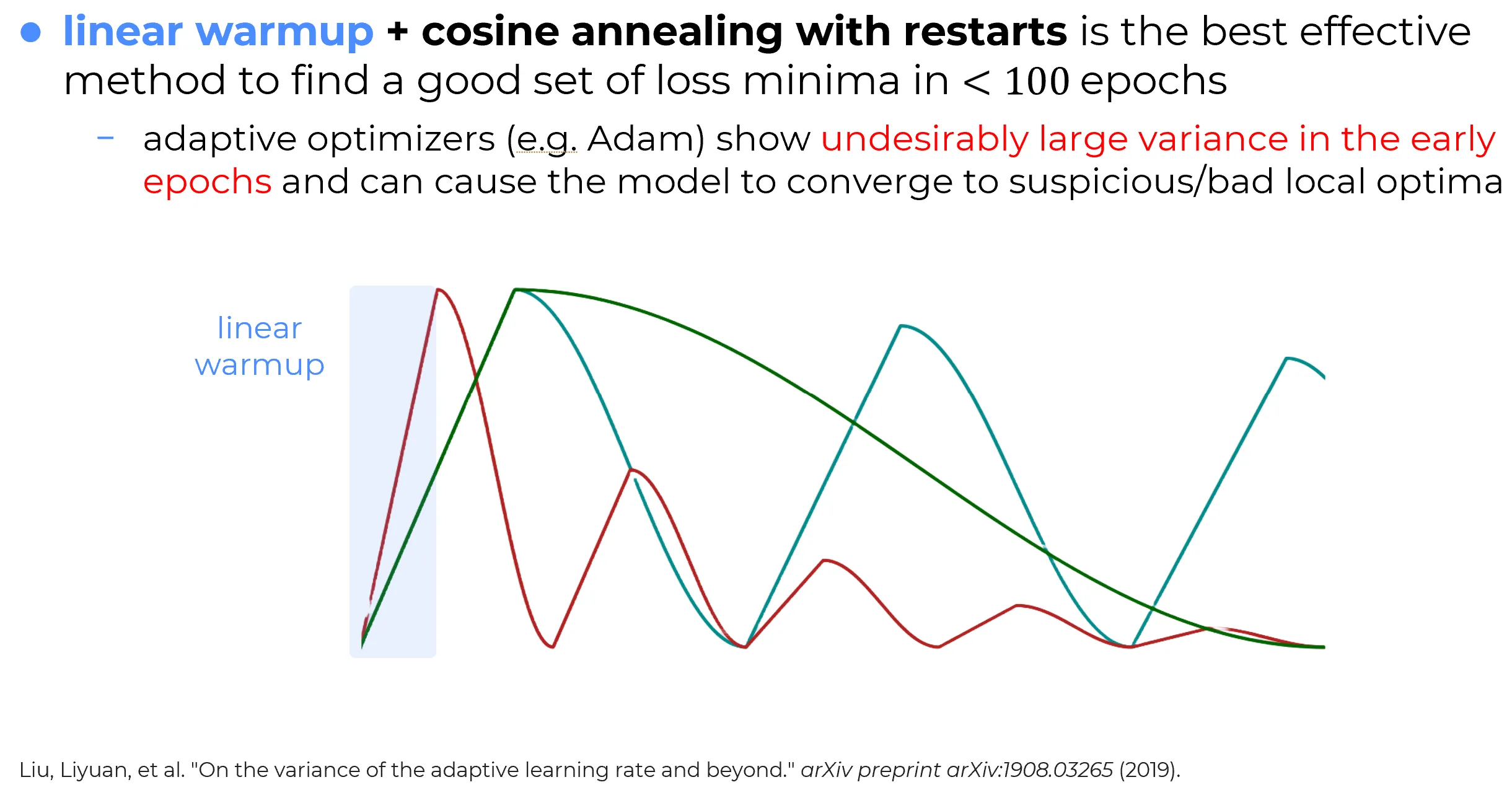
Why cosine is often effective
Once warm-up ends, the next question is how the learning rate should evolve during the main phase of training.
Cosine Annealing is compelling because it provides:
- a smooth decrease,
- no abrupt milestone jumps,
- a naturally gentle late phase.
Its closed-form schedule over one cycle is
This makes it suitable as a main schedule after warm-up because:
- training first reaches the intended working learning rate,
- then decays smoothly,
- then ends in a low-learning-rate exploitation regime.
Why warm-up + cosine is so often effective
The pipeline decomposes training into two phases with distinct purposes:
- warm-up stabilizes the startup,
- cosine decay governs the main exploration-to-exploitation trajectory.
This separation of roles is one of the main reasons the combination is so widely used.
Cosine quietly commits you to a training length
Cosine annealing is defined as a fraction of the run: the rate at step depends on , so the total horizon must be fixed before training begins. This is the selection criterion most easily overlooked. Stopping early lands on a rate still well above , forfeiting the gentle low-rate tail that gives cosine much of its value; continuing past leaves the schedule undefined. When the stopping time is genuinely unknown, a schedule that does not bake in the horizon, a constant rate with a short final decay or a metric-driven step decay on validation plateaus, is the safer default, precisely because it can be stopped at any moment without wasting the tail.
Restart-based schedules
Warm-up + cosine + restarts
An even more aggressive strategy is to combine warm-up with cosine annealing with restarts.
The resulting training pipeline has the following structure:
- a short conservative startup phase,
- a first cosine exploration-to-exploitation cycle,
- one or more later cycles in which the learning rate is reset and the process repeats.
This can be powerful because each cycle gives the optimizer a new opportunity to explore a different trajectory through parameter space.
High-level rationale
The idea is not that every restart must improve the model. The idea is that a single monotone schedule explores only one decay trajectory, while restarts allow several distinct exploration-exploitation phases within the same training run.
Why restart-based scheduling can help
This strategy attempts to address two different needs simultaneously:
- initial stabilization, handled by warm-up;
- multi-cycle exploration, handled by cosine restarts.
Thus:
- warm-up protects the startup,
- cosine decay controls the internal shape of each cycle,
- restarts periodically reintroduce exploration.
Practical interpretation
This is best understood as an empirical high-performance recipe, not as a universally optimal theorem. It is often powerful, but it is not automatically the right choice for every training budget or every task.
Not a universal default
Note
The combination of warm-up, cosine annealing and restarts is powerful, but not always the correct default.
It may be excessive when:
- the training budget is short,
- startup instability is not a real issue,
- a single monotone decay already works well,
- the extra complexity of restart tuning is not justified.
Complexity should be earned
A sophisticated scheduler should be adopted because it solves a concrete problem:
- unstable startup,
- excessive sensitivity to milestones,
- poor late-stage exploitation,
- or the need for multiple exploratory cycles.
It should not be adopted merely because it is more elaborate.
Decision rule
The following rule is a strong practical starting point.
A robust scheduler-selection heuristic
- Start with a simple monotone decay baseline.
- If the early phase is unstable, add warm-up.
- If milestone-based decay feels too abrupt, try cosine annealing.
- If a single decay trajectory seems limiting and the compute budget allows it, consider cosine annealing with restarts.
- Only keep the more complex scheduler if it yields a genuine empirical advantage.
This is a better workflow than beginning immediately with the most elaborate pipeline.
PyTorch implementation details
In PyTorch, multiple schedulers can be chained using SequentialLR.
This makes it easy to express the common pattern:
- first a warm-up phase,
- then a main scheduler.
Practical PyTorch caution
SequentialLRswitches schedulers after a specified number of scheduler steps. Therefore, itsmilestonesmust use the same time unit as the frequency with whichscheduler.step()is called. If stepping is done per epoch, the milestone counts epochs. If stepping is done per iteration, the milestone counts iterations.
Example
from torch.optim.lr_scheduler import SequentialLR, LinearLR, CosineAnnealingWarmRestarts

optimizer = torch.optim.Adam(model.parameters(), lr=1e-3)

# 1. Warm-up scheduler
# Linear growth from 0.1% of the base LR up to the full base LR in 5 scheduler steps
warmup_scheduler = LinearLR(
    optimizer,
    start_factor=1e-3,
    end_factor=1.0,
    total_iters=5,
)

# 2. Main scheduler
main_scheduler = CosineAnnealingWarmRestarts(
    optimizer,
    T_0=10,
    T_mult=2,
    eta_min=1e-5,
)

# 3. Sequential composition
# The warm-up runs for the first 5 scheduler steps, then the cosine-restart schedule begins
scheduler = SequentialLR(
    optimizer,
    schedulers=[warmup_scheduler, main_scheduler],
    milestones=[5],
)
What this example really means
The code above is correct only after the scheduler time unit has been fixed. For example:
- if
scheduler.step()is called once per epoch, thentotal_iters=5means 5 epochs of warm-up andT_0=10means 10 epochs in the first cosine cycle;- if
scheduler.step()is called once per batch, then both quantities are measured in iterations instead.
Summary
The choice of a learning-rate scheduler should be governed by the role the scheduler must play in the training dynamics.
The decision rule above turns that into a concrete order of attack: a monotone baseline first; warm-up only against genuine startup instability; cosine for a smoother main descent; and restarts only when the budget and the task reward several exploratory cycles.
Final takeaway
A strong scheduler is not the one with the most moving parts. It is the one whose structure matches the actual needs of the training process:
- stabilization at the start,
- controlled decay in the middle,
- and exploitation or renewed exploration later on.