Abstract
Connectionism is the tradition behind modern AI that treats intelligence not as a set of explicit rules but as an emergent property of large networks of simple, adaptive units. Its single most consequential idea is the distributed representation: a concept encoded as a pattern of activity across many units rather than stored in one dedicated symbol. This note concentrates on what is distinctive about the paradigm, leaving the unit it is built from to the artificial neuron and the milestones that made it trainable to the history of neural networks.
Symbolic AI, mapped in the evolution of AI paradigms, answered the question “how is intelligence specified?” with explicit symbols and rules. Connectionism gives a different answer, and the difference is not one of implementation but a change of where intelligence is taken to live.
Intelligence as emergence
The central claim of connectionism is that intelligent behaviour need not be written down. It can arise from the interaction of many simple units whose connections are gradually modified by experience. Knowledge, in this view, sits in no single location; it is distributed across the pattern of connections the system has acquired.
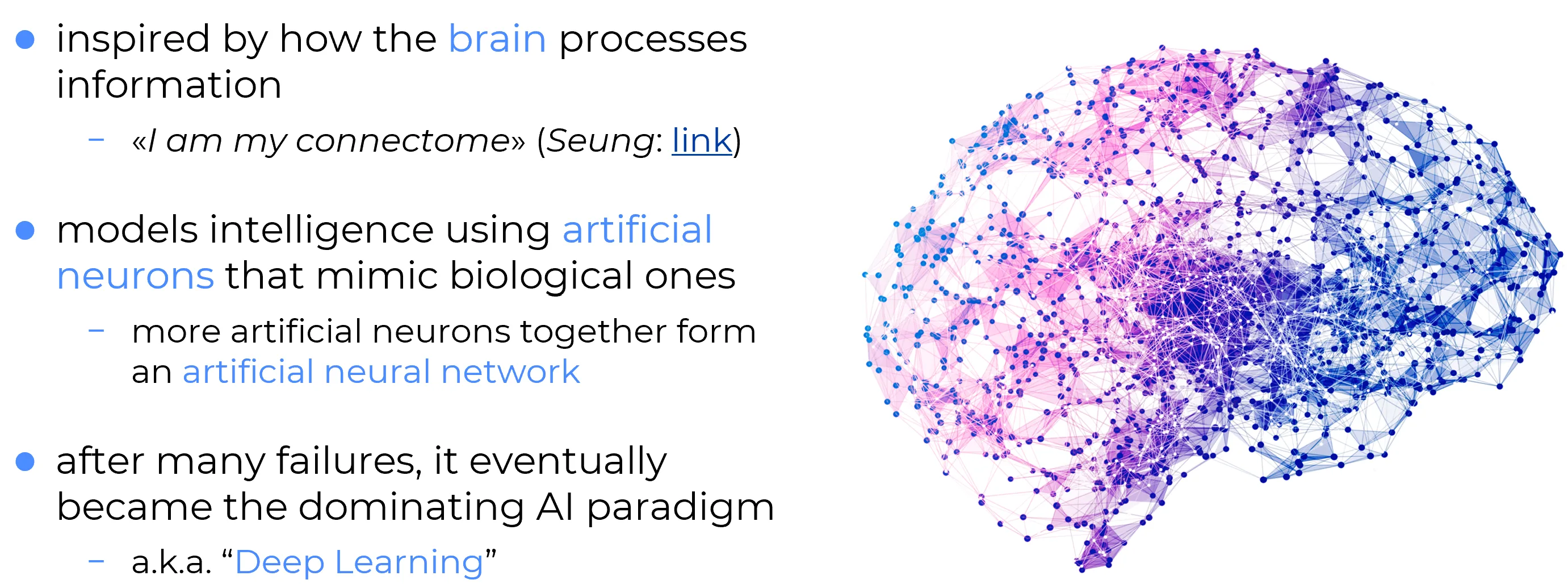
The inspiration is biological. The brain contains on the order of billion neurons joined by a vast web of synapses, and no single cell carries meaning on its own. What matters is the structured pattern of interaction across many cells, and learning appears as synaptic plasticity, the strengthening and weakening of connections through use. Sebastian Seung compressed the idea into a slogan.
"I am my connectome."
The claim is not that a person reduces to a wiring diagram in any crude sense. Its point is conceptual: memory, skill, and identity are read as emerging from the organisation of connections, not from a privileged location in the system.
A caution belongs here, because the analogy is easy to overdraw. Artificial networks are inspired by the brain, not faithful to it. The artificial neuron discards spikes, dendritic dynamics, neurotransmitter chemistry, and almost all of the structure of real nervous tissue. Connectionism is best understood as a computational abstraction of large-scale adaptive networks, not as a model of neurobiology.
The signature idea: distributed representation
The deepest contribution of connectionism is a shift in how a concept is represented.
In a localist scheme, one unit stands for one concept. The representation is easy to read, but brittle: if that unit fails the concept is gone, and nothing relates one concept to another. In a distributed scheme, a concept is a pattern of activity across many units. Meaning lives in a vector, not in a single symbol.
Why distributed representations changed everything
Because concepts are vectors, related concepts can occupy nearby regions of a representation space. This is what lets a network generalise: it does not store isolated symbols, it organises knowledge geometrically, so that similarity, analogy, and interpolation become operations on vectors. Word embeddings, latent codes, hidden states, and feature maps are all distributed representations, and the semantic behaviour of large language models (clustering, analogy, graded similarity) rests entirely on this vector-based view of meaning.
This single move, from symbol to vector, separates connectionist systems from their symbolic predecessors more sharply than any architectural detail.
Why the paradigm prevailed
Connectionism became dominant not because it was philosophically attractive but because it turned intelligence into a problem that could be solved by optimisation. Instead of specifying the relevant features and rules in advance, one defines an architecture, a learning objective, and a training procedure, then lets the system discover useful internal structure from data.
The practical force of this rests on a few properties that reinforce one another:
- Representation learning. A network does not merely fit outputs to inputs; it learns an internal space in which the problem itself becomes easier. The XOR function, impossible for a single linear unit but easy for a small network that first transforms its input, is the textbook case, developed in the history of neural networks. A hidden layer acts, in effect, as a learned change of coordinates.
- End-to-end differentiability. When every part of the model is differentiable, the whole pipeline can be optimised jointly by backpropagation rather than engineered one stage at a time.
- Scalability. Performance tends to improve, often predictably, as data, model size, and computation grow, which aligns the paradigm with decades of hardware progress.
- Architectural flexibility. The same core can be specialised into many forms without abandoning its principles.
The decisive advantage
Connectionism reframes intelligence as optimisation over representations. Every other choice, the architecture, the objective, the training recipe, is in service of letting useful internal structure emerge from data instead of being specified by hand.
One paradigm, many architectures
Modern deep learning is not a break from connectionism; it is its most computationally successful form. What changes from one architecture to another is not the connectionist core but the inductive bias imposed on how units interact.
- Convolutional networks build in spatial locality and weight sharing.
- Recurrent networks and LSTMs extend the same learning into sequential and temporal data.
- Transformers replace recurrence with attention while still relying on distributed learned representations optimised end to end (history of Transformers).
- Graph neural networks generalise the computation to relational data, and autoencoders and diffusion models to compression and generation.
The deep learning era did not replace connectionism. Larger datasets, stronger optimisers, better architectures, and GPU-scale computation turned a long-standing theoretical stance into the dominant engineering paradigm of AI.
Limits and the open frontier
Connectionism is powerful, not finished, and several debates remain genuinely open.
| Issue | The open question |
|---|---|
| Biological plausibility | Backpropagation and many standard components do not resemble known brain mechanisms. |
| Interpretability | Distributed representations are effective but hard to read mechanistically. |
| Reasoning and structure | Whether symbolic compositionality, causal reasoning, and explicit planning emerge from distributed learning alone is contested. |
| Grounding | Purely data-driven systems can acquire statistical competence without sensorimotor grounding in a world. |
These do not invalidate the paradigm; they mark its frontier, the question of how far adaptive distributed systems can go on their own and what, if anything, must be added to them. That question is taken up directly in the debate over prediction and the nature of intelligence.
Summary
Connectionism is the architectural foundation of modern AI because it frames intelligence as an emergent property of learnable networks of interacting units. Its enduring contributions are three: that knowledge can be held in distributed representations rather than discrete symbols, that learning is the adaptive modification of connections, and that complex behaviour can emerge from large-scale interaction among simple components. Contemporary deep learning is not a departure from these ideas but their largest-scale realisation.